
Recently I’ve mentioned thoughts about desert camps and camping in hot, arid valleys (as you might find in Morocco) on these pages, but given the dark nights and cold which prevails for much of the year in Europe it might be an idea to look at camping and travel in the winter months in the UK and some of Europe. This page will not cover “serious” continental winters, rather it looks at the more temperate winters found in the UK and western Europe
It puts many people off – packing tents away in the rain, camping in the grey and cold, waking up in a tent when there’s frost and snow around. Diesel vehicles can be reluctant to start in low temperatures, road surfaces can be slick with black ice, and so on. Yet it can also be one of the most rewarding environments to travel and make camp in.

Wet conditions can be the most off-putting. Nobody likes putting soaking wet tents away. Yet there are ways round this. Tuff-Trek sell an excellent elasticated roof tent Rain Cover (their “Storm Cover” in a variety of sizes) which packs away small and yet fits snugly over most “soft top” roof tents to protect them from heavy rain. You simply remove the cover when it’s time to strike camp, and fold away your dry tent. You then stash the compact raincover somewhere where you can dry it out easily. Prices start at £90. You can of course rig ponchos or tarps to do the same job, but it’s fiddly. Tuff Trek are also developing a tent liner which insulates roof tents in lower temperatures. I have one on order, so I’ll pass on feedback here when I can.
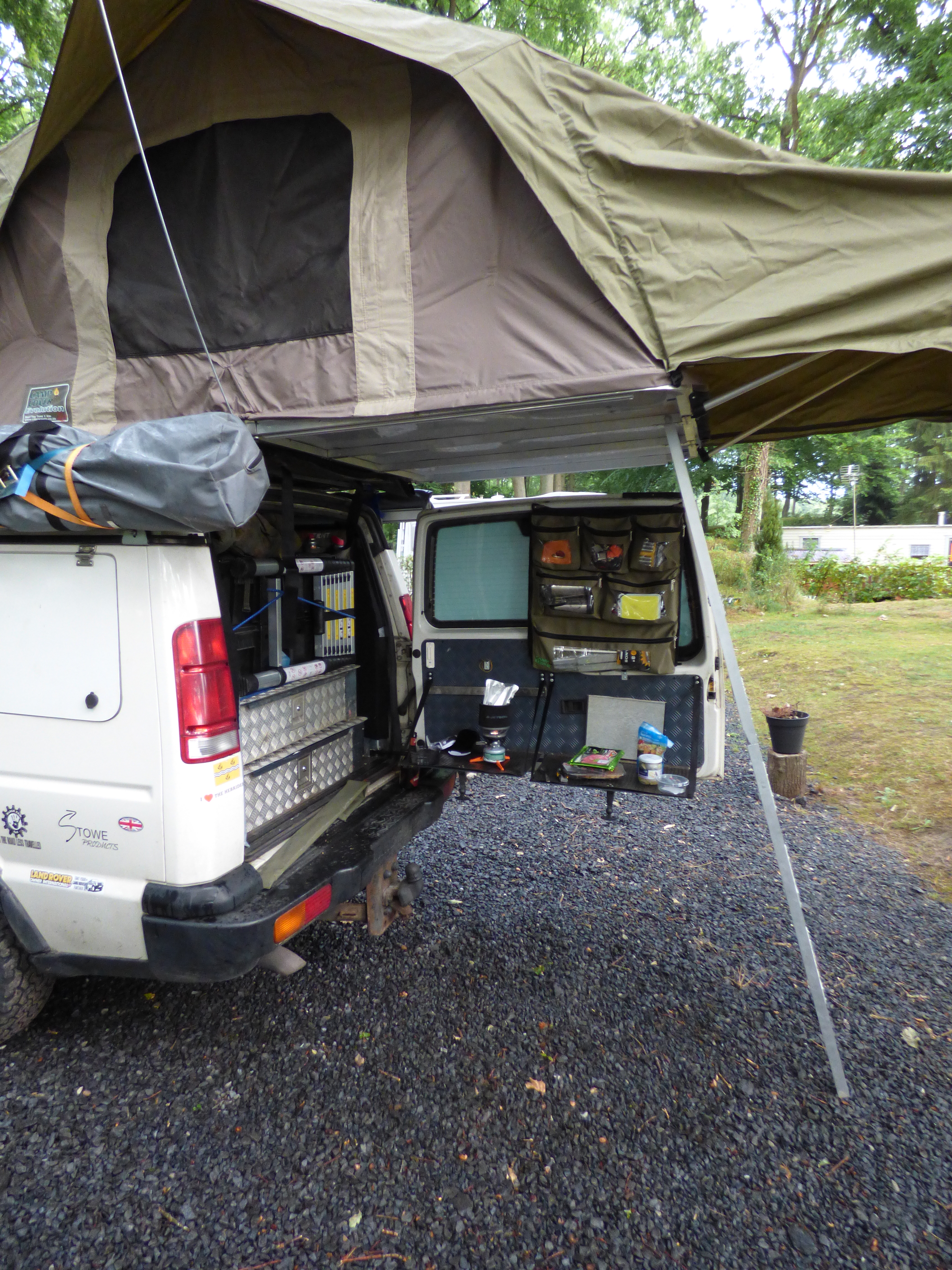
Equally, many prefer to sleep inside the vehicle when the weather is bad. With LWBs it’s reasonably easy to arrange a fold-down bed system (for example the bunkbed system – frame, hinges and all – from a 1980s Sprite Alpine caravan slots perfectly into the loadbay of a Defender 110 hardtop…. giving a bench seat which transforms easily into a double-deck bunkbed). There are also options for short wheelbase vehicles. The Bezzitec folding single bed system has been mentioned in magazines before for SWB vehicles, though sadly they are no longer available new. However it’s reasonably easy to fangle your own setup, even in a very short vehicle, once you fold the front seats forward and get ingenious with bits of wood. Certainly, sleeping inside a vehicle is easier when weather gets really foul. You do however need to be aware of condensation issues (extra vents help – cheap on ebay) and carbon monoxide buildup if you use gas-powered cookers or heaters (not wise inside a vehicle). This latter is important – it can kill you.
Last winter there was a sudden ripple of interest in diesel heaters for the inside of 4x4s – perhaps the most popular (apart from the perennial Eberspacher units and similar) being the Planar heater from Russia. These are very reliable (when properly installed) thermostatically controlled heaters which burn diesel (either from your main tank or an auxiliary tank) and create a good deal of warmth for those sleeping in a vehicle. They will run for a couple of days on a leisure battery without charging, and they use about a litre of diesel a day if you leave them on continually. Planarheaters.co.uk are a good installer, though there are others. As for pricing, a 2kw model costs about £700 installed, and the 2kw model churns out plenty of heat for a big 4×4.
If you put an awning up in bad weather, beware of two things – the weight of rainwater collecting on top (pitching it with a slope to allow runoff is a good idea, as is creating a small ‘peak’ with a spare tent pole for the same reason) and also the ease with which wind can pick the awning up. Anchoring them down with extra straps helps, and awnings such as the Eezi Awn have sidewalls with skirts that you can weight down with rocks or snow in bad weather.
Diesel engines don’t like the cold, and when the temperature drops below -10°C the diesel starts to freeze in engines, causing difficulty (it’s the paraffin wax in the mixture that freezes). The same is true for additives like AdBlue, for those Land Rovers that use it. Healthy, newer glowplugs can help, and Winter Diesel is a must in countries where it’s available, like the UK (it’s sold as standard in winter). Part of the problem is diesel fuel freezing in the fuel filter, which then blocks, causing engine damage. Insulating the filter helps with, for example, a neoprene sleeve. Also be aware the fuel filter tends to ice up due to windchill if cold air is moving quickly over it. If you are venturing into really cold places, do some more research on this topic before setting out.

Driving in snow is a topic that needs a detailed discussion other than here – just be aware that when battering your way through snowdrifts, snow can “ball up” at the bottom of your engine bay and freeze solid. This can cause engine damage (for example the bottom of the dipstick tube in my Camel Trophy Discovery snapped off once because of this, and I lost most of my oil) and can also lead to the Land Rover sitting on a thick cushion of frozen hardpacked snow which prevents your wheels getting enough traction to move forward. Shovelling snow out of the way is seldom a waste of time!
 Sam Watson
Leave a comment